
OBI Supports Canada's Next Generation of Neuroanalytics Leaders with the CNS Program's Second Cohort
April 16, 2026
Spanning nine institutions from the East Coast to Alberta, the Canadian Neuroanalytics Scholars (CNS) Program has announced its second cohort — continuing its national mission to build Canada's capacity for data-driven neuroscience research.
Launched in 2024, the CNS Program supports and trains postdoctoral scholars in advanced analytics, providing hands-on experience in cutting-edge computational methods. The program connects infrastructure, resources, and expertise across leading research and industry partners nationwide, with the goal of cultivating a world-class talent pool capable of effectively utilizing open neuroscience data and meeting the growing demand for neuroscience research in artificial intelligence and machine learning.
With scholars embedded within Canada's leading neuroscience hubs, the program offers early-career postdocs the opportunity to work with research and industry partners across the country while gaining interdisciplinary technical and translational skills. The cohort's national reach and collaborative model reflects the program's broader ambition: to position Canada as a leader at the intersection of brain science and advanced analytics.
By harnessing open neuroscience data, the CNS Program promotes collaboration, transparency, and shared scientific progress across institutions and disciplines. This collective, data-driven approach enhances rigour and reproducibility in research, strengthening Canada's capacity to lead in the knowledge and innovation economy shaped by AI and machine learning.
Meet the Second Cohort
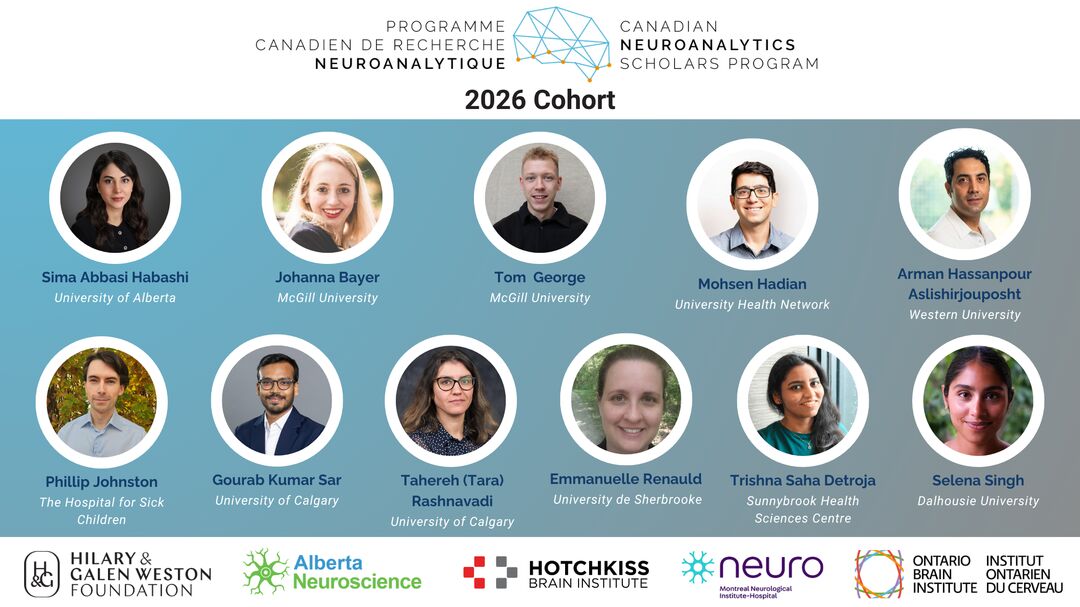
The 11 scholars selected for this cohort bring a remarkable breadth of expertise — spanning neurodegeneration, epilepsy, mental health, pediatric brain injury, and chronic pain — united by a shared commitment to advancing neuroscience through data-driven methods.
Sima Abbasi Habashi — University of Alberta (Edmonton, AB) Multi-Modal Machine Learning to Uncover Genetic and Immune Pathways Driving White Matter Hyperintensities and Cognitive Decline
Johanna Bayer — McGill University (Montréal, QC) Personalized Deep Longitudinal Normative Modeling for Tracking Parkinson's Disease Progression
Tom George — McGill University (Montréal, QC) Foundation Models for Neuroscience: From Open Brain Data to Neurodegenerative Disease Prediction
Mohsen Hadian — University Health Network (Toronto, ON) Prognosticating Alzheimer's Disease Progression Using Multimodal Biomarkers: An Explainable AI Approach with ADNI
Arman Hassanpour Aslishirjouposht — Western University (London, ON) Multimodal Machine Learning for Monitoring and Predicting Speech and Motor Symptoms in Neurodegenerative Diseases Using Open Neuroscience Data
Phillip Johnston — The Hospital for Sick Children (Toronto, ON) Detecting Invisible Brain Injury from Repeated Head Impacts in Youth with Generative Modelling and Machine Learning
Gourab Kumar Sar — University of Calgary (Calgary, AB) Functional Role of Partial Synchronization in Neurological Diseases
Tehereh (Tara) Rashnavadi — University of Calgary (Calgary, AB) Causal Network Inference in Drug-Resistant Epilepsy Using Information-Theoretic Granger Causality with Neural Network-Based Feature Learning on Intracranial EEG-fMRI
Emmanuelle Renauld — Université de Sherbrooke (Sherbrooke, QC) Efficient Classification of Chronic Back Pain via Minimal Data Aggregation from Multi-Site Multi-Modality Open Datasets
Trishna Saha Detroja — Sunnybrook Health Sciences Centre (Toronto, ON) Unraveling the Role of Sleep-Related Cortical Cell Type Subpopulations in Sleep, Dementia-Related Brain Changes, and Dementia in Aging
Selena Singh — Dalhousie University (Halifax, NS) Predicting Treatment Response and Relapse in Major Depression Using EEG Signatures of Neural Attractor States
We are proud to celebrate the second CNS cohort and the outstanding scholars driving this national mission forward.
About Canadian Neuroanalytics Scholars (CNS) Program
The CNS Program is led by Alberta Neuroscience, the Hotchkiss Brain Institute, and The Neuro (Montreal Neurological Institute-Hospital), with funding from the Ontario Brain Institute (OBI) and The Hilary and Galen Weston Foundation.